


Your friendly guide to choosing the right acne strategy—without overthinking it.
If you’ve ever stood in front of your mirror wondering whether you should dab on a spot corrector or commit to an all-over acne serum… you’re not alone. Acne is one of those things that feels deceptively simple, but the type of acne you have—and how often it shows up—changes the kind of treatment your skin needs.
Think of two completely different skin days:
- Day 1: A single red pimple appears on your chin right before a big event. Everything else looks clear.
- Day 2: You wake up to multiple bumps across your cheeks and jawline, and new ones keep showing up every few days.
Both are acne.
But they don’t need the same plan.
This blog will help you figure out exactly when to use a spot corrector, when to switch to a full-face treatment, and where hybrid gels fit into the picture. By the end, you’ll be able to make the right call instantly—even before your next breakout happens.
When Spot Correctors Make the Most Sense (Occasional Acne)

Spot correctors are like tiny firefighters: small, targeted, and designed to put out one specific flare-up.
What “Occasional Breakouts” Actually Looks Like
Occasional acne typically means:
- You get one or two pimples at a time
- They often appear before periods, after stress, or after sweating
- They appear in specific spots (like the chin or forehead)
- The rest of your skin stays fairly calm throughout the month
This is when a full-face acne serum becomes excessive—like using a fire hose to put out one small flame.
Why Spot Correctors Work So Well for This Type of Acne
Spot treatments are designed to:
- Deliver higher-potency active ingredients directly on a small bump
- Reduce the risk of dryness or irritation that would happen if the same formula was applied everywhere
- Shrink whiteheads or inflamed bumps faster
- Avoid compromising the moisture barrier
Dermatologists often recommend spot treatments for these specific situations.
In a Miiskin dermatology article on acne spot treatment, experts explain that spot products are ideal for handling “individual lesions that appear occasionally” and help avoid overtreating the rest of the skin (Miiskin, Best On-The-Spot Treatments for Acne).
Spot treatments are also great under makeup: they’re light, they absorb fast, and you won’t feel like you’re layering 10 things on your face.
When to Reach for a Spot Corrector Immediately
- A red, angry pimple the night before an event
- A predictable “period pimple”
- A sudden whitehead from stress or sweating
- A random breakout that isn’t part of a pattern
If you’re someone who rarely breaks out—or breaks out only in the same little spot—spot correctors are the best way to treat acne with minimal fuss.
When Full-Face Acne Serums Are the Better Choice (Persistent + Hormonal Acne)
If acne shows up again… and again… and again… your skin probably needs more than a targeted dot of treatment.
What Persistent or Hormonal Acne Looks Like
Persistent acne includes:
- Frequent or near-daily breakouts
- Multiple lesions appearing at once
- Acne that comes in cycles (especially around periods)
- Breakouts on multiple areas—cheeks, jawline, forehead
- Texture changes like tiny bumps or clogged pores
Full-face treatments help regulate the environment of your skin, not just the occasional bump.
Why Full-Face Treatments Work for This Type of Acne
Unlike spot correctors, full-face acne serums target the root causes of acne:
- Excess oil production
- Irregular cell turnover that causes clogged pores
- Bacterial overgrowth (C. acnes)
- Inflammation that leads to red, painful spots
- Hormonal sebum fluctuations
According to the Mayo Clinic’s guidance on nonprescription acne treatments, applying acne ingredients across the full face is more effective for preventing new breakouts than treating isolated ones after they’ve appeared (Mayo Clinic, Nonprescription Acne Treatment).
This is especially true for:
- Blackheads
- Tiny bumps
- Fungal acne–like congestion
- Whiteheads that reappear every week
What Happens If You Use Only Spot Correctors for Persistent Acne
Spot treatments will shrink a pimple…
but they won’t stop new ones from forming.
If you have:
- Several new pimples weekly
- Acne in more than one region
- Ongoing congestion in cheeks/jawline
…spot correctors alone become a “band-aid solution.”
You may end up constantly treating individual spots without ever solving the underlying reasons they keep appearing.
Switch to a full-face regimen when acne becomes:
- Frequent
- Patterned
- Predictable
- Widespread
You’ll save time, frustration—and probably money too.
The Middle Ground: Hybrid Gels for Sensitive or Oily Skin
Not everyone needs a heavy full-face serum.
And not everyone likes applying thick creams across the face.
This is where hybrid gels shine.
What Is a Hybrid Gel?
A hybrid gel is a lightweight formula that:
- Works like a spot corrector when applied on individual lesions
- Can be used as a “zone treatment” on areas that break out more often
- Is gentle enough for oily or sensitive skin
- Layers easily under sunscreen and makeup
Think of it as a flexible, adaptable acne solution.
It doesn’t lock you into one method—you can use it where you need it, when you need it.
Why Hybrid Gels Are Better for Oily or Sensitive Skin
Hybrid gels tend to have:
- Fewer occlusives (less pore-blocking potential)
- Low irritation risk
- A clear, invisible finish
- Better absorption
- Non-comedogenic formulations
Glamour’s “Best Spot Treatments for Acne” roundup highlights how lightweight gels are dermatologist favorites because they reduce pimples without suffocating oily or reactive skin (Glamour, Best Spot Treatments).
If your acne pattern looks like:
-
Just your T-zone
-
Only your jawline
-
Only your chin during periods
…a hybrid gel as a zone treatment can be a perfect match.
How to Pick a Good Hybrid Gel
Look for these clues on the label:
- “Non-comedogenic”
- “Oil-free”
- “Clear gel”
- “Spot + zone use”
- “Lightweight”
- “Absorbs quickly”
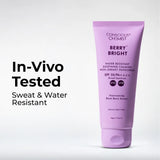
If you need a starting point, Conscious Chemist’s Berry Bright Spot Corrector Gel is designed exactly this way—lightweight, flexible, and suitable for both single spots and breakout-prone zones.
The Easy Decision-Tree: Which One Do You Need?
Let’s simplify it into three quick questions:
Question 1: How many spots do you have right now?
- Just one or two? → Spot corrector
- Multiple popping up repeatedly? → Full-face treatment
- Only one area keeps breaking out? → Hybrid gel as zone treatment
Question 2: Does your acne come with a pattern?
- Random & rare → Spot corrector
- Weekly or monthly breakouts → Full-face serum
- Only on T-zone or hormonal zones → Hybrid gel
Question 3: What’s your skin type?
- Oily + sensitive → Hybrid gel
- Normal + mild acne → Spot corrector
- Oily + persistent acne → Full-face treatment
After answering these, you’ll know exactly what to do.
FAQs
1. When should I use a spot corrector instead of an acne serum?
Use a spot corrector when you only get occasional pimples or isolated zits. It delivers targeted action without irritating the rest of your face. Dermatologists recommend this approach for people who break out rarely (Miiskin).
2. I have only one pimple—should I still use full-face treatment?
Nope. It’s unnecessary. A targeted formula is enough.
3. What product is best for oily + sensitive skin?
A hybrid gel—lightweight, non-comedogenic, and gentle.
4. Can I use a spot corrector and a full-face acne serum?
Yes! Apply the serum first, then dab the spot corrector on stubborn bumps.
5. What is a “hybrid gel”?
A multitasking product that works as both a spot treatment and a zone treatment.
6. How fast should a spot corrector work?
You’ll usually see reduced redness and swelling within 24–48 hours.
7. If I break out only during periods, what’s best?
A hybrid gel or a spot corrector—depending on how many pimples appear.
8. When should I see a dermatologist?
If acne is painful, cystic, or affecting your confidence, a derm can help with stronger options (Mayo Clinic).
Final Takeaway
Acne may feel confusing, but treating it doesn’t have to be.
Here’s the simplest summary:
- One-off pimples? → Spot corrector
- Frequent breakouts? → Full-face treatment
- Breakouts in certain zones or sensitive skin? → Hybrid gel
When you understand your acne pattern, choosing the right solution becomes effortless—and much more effective.

Share:
Best Spot Treatments in India That Work in Hours (Not Days)
How Do I Fix My Skin Barrier Fast?