


Have you been using a complete hair care kit for hair fall or even the best hair growth kit for hair fall, but your hair still feels rough, dull, and harder to manage?
It is easy to assume the problem lies in your routine, your products, or even your genetics.
But in many Indian households, the real issue is much simpler and often overlooked.
It is the water.
If you are trying to invest in science-backed hair growth products, ignoring water quality can limit your results from the start. This guide helps answer your questions.
What Is Hard Water and How Does It Affect Your Hair Daily?
Hard water is water that contains higher levels of minerals, such as calcium and magnesium. This is especially common in borewell water, overhead tanks, and even some municipal supplies across Indian cities.
Every time you wash your hair with hard water, a small amount of these minerals stays behind on your hair and scalp. Over time, this buildup changes how your hair behaves.
Instead of feeling smooth and manageable, hair becomes rough, tangled, and less responsive to products. The cuticle becomes uneven, reducing shine and increasing friction between strands.
This is why your hair growth kit with biotin and caffeine or redensyl hair growth products may suddenly feel less effective.

Does Hard Water Cause Hair Fall or Something Else?
This is where most confusion begins.
Hard water does not directly cause sudden hair loss from the root. Instead, it affects the structure of your hair strands, making them weaker and more prone to breakage.
In controlled testing published in the International Journal of Trichology, hair exposed to hard water showed a noticeable reduction in fiber strength compared to hair washed with deionized water. This means the strands were more likely to snap under everyday stress, like brushing or tying hair. (Citation 1)
So what looks like increased hair fall is often actually breakage.
|
Key Takeaway Hard water usually does not cause sudden true hair loss, but mineral buildup weakens strands and increases breakage, which looks like more hair fall. |
How Does Hard Water Change Hair and Scalp Behavior Over Time?
The impact is gradual, which is why many people do not connect it to water.
As mineral deposits build up:
-
Hair loses its natural slip
-
Products stop rinsing clean
-
Strands become dry despite conditioning
-
The scalp begins to feel coated or slightly irritated
Microscopic studies have shown that hard water exposure leads to surface irregularities on hair strands, including mineral deposits along the cuticle. These deposits increase roughness and reduce smoothness, which explains persistent dullness and tangling. (Citation 2)
What Are the Signs That Hard Water Is the Real Problem?
If you are using a hair growth kit for thinning hair or even the best anti-hair fall kit in India, but your hair still behaves unpredictably, these patterns are worth noticing.
-
Hair Signs That Point to Hard Water
Hair affected by hard water often feels dry in a very specific way. It is not just a lack of moisture, but a lack of smoothness.
You may notice that your hair:
-
Looks dull even right after washing
-
Feels rough despite conditioning
-
Tangles more easily than before
-
Shows increased breakage while combing
This is because mineral buildup prevents the cuticle from lying flat, reducing both shine and flexibility.
-
Signs of Hard Water on Scalp Often Mistaken for Product Buildup
Many people assume they have dandruff or sensitivity, but the issue is often residue.
Hard water can leave the scalp feeling:
-
Slightly itchy or tight
-
Coated, even after washing
-
Prone to flakes that are actually buildup
If these symptoms started after moving to a new home or city, the connection becomes stronger.
-
Signs Your Hair Care Routine Is not Working Due to Hard Water
Your routine may also give subtle signals.
You might notice:
-
Shampoo is not lathering properly
-
Conditioner feels heavy but ineffective
-
Hair is getting greasy faster than expected
This happens because hard water interferes with how products interact with your hair, often leading to overuse and more buildup.
|
Key Takeaway If your hair feels coated, dries quickly, and breaks more during detangling, especially after you move, hard water is a likely suspect. |

Hard Water Hair Checklist
This quick checklist helps you connect common hair and scalp issues to possible hard water damage, along with simple fixes you can try right away.
|
What You Notice |
Likely Hard-Water Link |
Try This First |
|
Hair feels rough and dry |
Mineral buildup on the cuticle |
Try a clarifying wash |
|
Scalp feels coated |
Residue accumulation |
Rinse longer |
|
Hair breaks easily |
Reduced fiber strength |
Add a leave-in slip |
|
Hair looks dull |
Cuticle disruption |
Use lightweight products |
How Can You Check for Hard Water at Home Without Equipment?
You do not need a lab test to confirm this. A few simple checks can give you enough clarity.
-
Soap Lather Test: How to Check for Hard Water at Home?
Fill a bottle with tap water, add a few drops of liquid soap, and shake it.
If the foam is minimal and the water looks cloudy, it suggests higher mineral content. This happens because hard water reacts with soap, reducing its ability to lather effectively.
-
What Does Scale Buildup Around Your Home Indicate?
Look closely at your taps, showerheads, or kettles.
If you see white, chalky residue forming regularly, it is a strong indicator of water that is mineral-rich. The same minerals are likely depositing on your hair, too.
-
How Does Your Hair Respond to a Clarifying Wash?
A simple one-time test can be very revealing.
Use a clarifying or chelating shampoo once and observe the difference. If your hair suddenly feels smoother, lighter, and easier to manage, buildup was likely the issue.
This works because chelating agents help bind and remove mineral deposits from the hair surface.
|
Key Takeaway A simple soap-lather test, combined with visible scale buildup, is often enough to suspect hard water without special tools. |
-
What Routine Works Best for Hair Fall in Hard Water Conditions?
Once you identify hard water as the issue, the goal is not to fight your water, but to adapt your routine.
If you are searching for how to stop hair fall immediately, or how to fix hair breakage and hair fall, the answer lies in reducing stress on your strands and improving consistency.
-
Why Technique Matters More Than Products in Hard Water?
In hard water conditions, even a good product can underperform if the technique is not right.
For example, using too much shampoo to compensate for poor lather can increase buildup instead of cleaning effectively. Similarly, rinsing too quickly can leave mineral and product residue behind.
Small changes like rinsing longer, avoiding very hot water, and focusing shampoo on the scalp can significantly improve results.
-
How Often Should You Clarify or Chelate Your Hair?
Clarifying is not about frequent deep cleaning. It is about a periodic reset.
Most people benefit from doing this once every 2 to 4 weeks. This helps remove accumulated minerals without stripping the hair.
However, if your hair is very dry, chemically treated, or curly, you may need to space this out further and focus more on conditioning.
-
Does Oiling Help or Worsen Hard Water Buildup?
Oiling can be helpful, but only when used correctly.
Pre-wash oiling reduces friction during washing and helps protect the hair from dryness-related breakage. However, if not cleansed properly, oil combined with mineral deposits can feel heavier on the scalp.
This is why proper emulsification and rinsing become important.
-
What Type of Leave-In Products Work Best?
In hard water environments, lighter products perform better.
Heavy creams can trap mineral buildup, making hair feel coated faster. Instead, lightweight leave-in conditioners and non-sticky serums help restore slip without adding extra weight.
Hard Water Routine Planner
Use this simple hair care routine to reduce hard water damage and maintain healthy hair.
|
Step |
What to Do |
How Often |
Adjust If… |
|
Oil |
Pre-wash nourishment |
2–3 times/week |
Reduce if buildup |
|
Shampoo |
Gentle cleansing |
Every wash |
Double cleanse if oily |
|
Clarify |
Remove minerals |
2–4 weeks |
Less if dry |
|
Conditioner |
Restore slip |
Every wash |
Increase in dryness |
|
Leave-in |
Reduce breakage |
After wash |
Keep lightweight |
|
Serum/Spray |
Daily support |
Daily |
Adjust if heavy |
When Should You Consider a Shower Filter?
A filter can help reduce mineral exposure, especially if your water source is very hard.
However, it is not a complete solution.
Even with a filter, your routine still needs to include proper cleansing, occasional clarifying, and lightweight leave-ins.
Think of it as an added layer of support, not a replacement.
Why a Complete Routine Works Better Than Single Products
Hard water exposure is repetitive. This means damage is not a one-time event, but something that builds gradually.
A study published in the Journal of the Pakistan Medical Association observed that repeated exposure to hard water can weaken hair structure over time, increasing its susceptibility to breakage under normal stress.
This explains why using just one product, even the best hair density booster products, often does not give consistent results.
You need a system that supports your hair across multiple stages.

Why a Structured Hair Growth Routine Matters in Hard Water Conditions?
A well-designed ingredient-led hair growth routine works across:
-
Pre-wash protection
-
Effective cleansing
-
Post-wash detangling
-
Daily scalp support
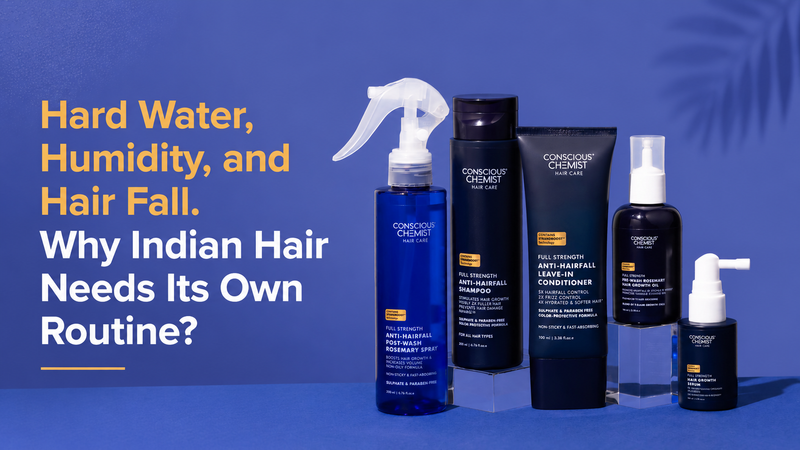
This is where a conscious chemist hair regrowth kit, designed as a premium hair growth system in India, fits naturally.
Instead of acting as a quick fix, it supports hair continuously through:
-
Oil for pre-wash nourishment
-
Hard-water-safe shampoo for gentle cleansing
-
Leave-in conditioner to reduce combing breakage
-
Lightweight spray and serum for daily scalp support
With ingredients like rosemary, peptides, caffeine, and Redensyl-based actives commonly used in clinically inspired hair care products, this type of routine focuses on reducing breakage and supporting density over time.
|
Key Takeaway In hard-water conditions, the goal is to gently remove mineral buildup and consistently restore slip. A lightweight, multi-step routine reduces breakage without weighing hair down. |
How Does Hard Water Impact Hair Over Time?
Hard water does not directly cause sudden hair loss, but it gradually affects how your hair behaves. Mineral buildup weakens strands, reduces smoothness, and increases breakage, which often gets mistaken for hair fall.
If your hair fall control products for daily use, or even a complete hair care kit for hair fall, are not giving the expected results, the issue may not be the product but the environment your hair is exposed to.
The focus should be on adapting your routine rather than constantly switching products. A consistent ingredient led hair regrowth routine that removes buildup, restores slip, and supports the scalp between washes helps reduce breakage and improves overall hair quality over time.
Which Hair Care Routine Works Best for Hard Water Conditions?
If your hair feels rough, breaks easily, or looks dull over time, focus on a routine that removes mineral buildup while maintaining hydration and slip between washes. This helps reduce friction, improve manageability, and prevent unnecessary breakage.
The Conscious Chemist hair growth kit combines oil, a hard-water-safe shampoo, and lightweight leave-in care to support your scalp and strands consistently across wash days and in between.
Order now and follow a consistent routine for a few weeks to see reduced breakage and smoother, healthier hair.
Frequently Asked Questions
1. Can hard water cause hair loss?
Hard water does not directly cause hair loss, but it can lead to increased breakage. Mineral buildup weakens the hair shaft, making strands more prone to snapping. This can make hair appear thinner over time.
2. How do I tell the difference between shedding and breakage?
Shedding involves full-length strands with a small white bulb at the root, which is normal. Breakage shows up as shorter, uneven pieces without a bulb. Excess breakage often indicates damage or dryness.
3. How often should I clarify in hard water?
Most people benefit from clarifying every 2 to 4 weeks to remove mineral buildup. If your hair feels very dry, reduce frequency. Adjust based on how your hair responds.
4. Will a shower filter fix everything?
A shower filter can reduce some mineral exposure, but won’t eliminate hard water effects. It works best when combined with a proper hair care routine. Think of it as supportive, not a full solution.
5. Is hard water worse for treated hair?
Yes, treated or chemically processed hair is more porous and absorbs minerals more easily. This can lead to faster dryness, dullness, and breakage. Extra care and conditioning are usually needed.
6. What if I cannot change my water supply?
You can still manage the effects with the right routine and techniques. Regular clarifying, gentle cleansing, and lightweight conditioning help reduce buildup. Consistency matters more than changing the water source.


Share:
Why Your Hair Is Falling or Thinning and How to Fix It the Right Way?
The 2-12 Week Hair Regrowth Timeline: What to Expect at Every Stage in 2026