


You wash your hair, and something feels off.
It does not feel clean, nor does it feel hydrated. It feels slightly coated, a little heavy, and yet the ends still look frizzy. This is where most people start searching for the right conditioner for hard water hair, assuming they just need a better product.
But the real issue is often misdiagnosed.
What feels like dryness can actually be buildup, and what feels like buildup can sometimes be roughness from damage. Treating one like the other usually makes hair feel worse over time.
What Does Buildup Feel Like on Fine Hair in Hard Water?
Buildup tends to show up more quickly on fine hair because the strands cannot withstand excess weight.
Hair may feel waxy or slightly sticky even after washing. It may fall flat quickly, lose volume at the roots, and start clumping together instead of moving freely. You may also notice that products stop “working” the way they used to.
This is not always due to the product itself, but rather because residue has already accumulated on the hair surface.

What Does Dryness or Damage Feel Like on Hair?
Dryness behaves very differently.
Hair feels rough and squeaky after washing, and tangles easily. Instead of feeling coated, it feels resistant to touch. Frizz increases, ends look dull, and combing requires more effort.
This is where confusion happens because dry hair can still feel heavy if the cuticle is uneven and catches product.
How to Check Buildup vs Dryness with a Simple Slip Test?
Right after rinsing your shampoo, run your fingers through your hair.
If your hair feels squeaky and tangles immediately, it is likely due to dryness. If it feels slippery but heavy and takes effort to rinse fully, it may be buildup.
This is not a perfect test, but it helps guide your next step.
Before changing your routine, this quick comparison can help you decide what your hair is actually experiencing.
|
What you notice |
More likely buildup |
More likely dryness/damage |
What to do next |
|
Hair feels waxy or coated |
Yes |
No |
Reduce layering and clarify occasionally |
|
Hair feels squeaky and rough |
No |
Yes |
Add lightweight conditioning |
|
Hair gets flat quickly |
Yes |
Sometimes |
Use lighter products |
|
Hair tangles easily |
Sometimes |
Yes |
Improve slip |
|
Key Takeaway If your hair feels coated and flat, it is likely buildup. If it feels rough and tangled, it is more likely due to dryness or damage. |
Why Does Hard Water Make Conditioner Buildup More Noticeable?
Hard water contains minerals like calcium and magnesium that interact with cleansing agents.
Instead of rinsing away completely, some residue can stay on the hair. This creates a slightly rough or coated surface, which changes how your hair feels and behaves.
This does not necessarily mean immediate damage, but it affects manageability.
Does Hard Water Affect Hair Strength and Texture?
Research on hard water is not entirely one-sided.
One study reported no significant difference in tensile strength or elasticity between hair washed with hard water and distilled water.
However, another study found a significant decrease in baseline hair strength after exposure to hard water compared to deionized water.
This suggests that the effect depends on hair type, condition, and routine.
Why Does Fine Hair Feel This More Than Thick Hair?
Fine hair has less structural volume.
Even a small amount of residue can weigh it down, making it look limp and feel greasy faster. This is why heavy masks, oils, and conditioners tend to feel worse in hard water conditions.
The issue is not always the product itself, but how it behaves in your environment.
|
Key Takeaway Hard water does not affect everyone the same way, but it can make buildup and roughness more noticeable, especially on fine hair. |

Which Conditioner Works Best in Hard Water Without Causing Buildup?
Frizz and breakage are closely linked.
When the hair surface is rough, strands catch against each other. This increases friction, which leads to tangling and snapping. Conditioning works by smoothing this surface and improving manageability.
Studies show that conditioning agents can reduce surface hardness and improve hair smoothness, which directly affects how easily hair moves.
Why Are Lightweight Leave-In Conditioners Better for Frequent Use?
Heavy masks may feel effective initially, but they can leave behind residue when used frequently, especially in hard water.
Lightweight leave-ins are designed to stay on the hair without weighing it down. They provide enough slip for detangling while maintaining movement and volume.
For fine hair, this balance is critical.
How Should You Choose Between Leave-In, Mask, and Oils?
Instead of avoiding certain ingredients completely, it is more useful to understand how often and in what amounts to use them.
Before deciding, this guide helps simplify what works best.
|
Product type |
Best for |
Frequency |
Buildup risk |
How to use |
|
Leave-in conditioner |
Daily slip and frizz control |
Frequent |
Low |
Use a small amount on lengths |
|
Rinse-out conditioner |
Wash day softness |
Regular |
Medium |
Avoid the scalp |
|
Hair mask |
Deep conditioning |
Weekly |
High |
Use sparingly |
|
Oils/serums |
Shine and sealing |
Occasional |
Medium–high |
Apply only on the ends |
Why Easy-to-Rinse Conditioners Work Better in Hard Water?
Products that rinse easily tend to perform better over time.
If a product requires excessive amounts to detangle or feels difficult to wash out, it can contribute to buildup. Choosing lightweight, easy-to-rinse formulas improves consistency.
|
Key Takeaway For fine hair in hard water, lightweight conditioning that improves slip without heaviness works better than rich, heavy products. |
How to Apply a Conditioner Without Causing Buildup?
Many build-up issues come from how products are used.
Applying conditioner too close to the scalp or using too much can create a coated feeling, even with good formulas.
How Much Conditioner Should You Actually Use?
Most people use more than they need.
Start with a small amount and spread it evenly. Adding a few drops of water while applying helps distribute the product better and prevents over-concentration in one area.
Where Should You Apply Conditioner for Best Results?
Focus on mid-lengths and ends.
These areas are older, more damaged, and need more conditioning. The scalp usually does not need additional product unless specifically required.
What Happens When You Layer Too Many Products?
Layering multiple products can quickly lead to buildup.
For example, using a leave-in, then oil, then serum can create excessive coating, especially in hard water. Keeping your routine simple helps maintain balance.
How Do You Reset Hair When It Starts Feeling Coated?
If your hair feels heavy or unresponsive:
-
Use a clarifying wash occasionally
-
Follow with lightweight conditioning
-
Simplify your routine for a few washes
Avoid over-clarifying, as it can increase dryness and frizz.
|
Key Takeaway Most buildup problems come from over-application and layering, not just the conditioner itself. |
How to Build a Weekly Routine to Prevent Hard Water Buildup?
A routine should be easy to repeat.
Washing 2–4 times a week with a gentle cleanser, followed by a lightweight leave-in, helps maintain balance. On non-wash days, only a small amount of leave-in on the ends is enough.
Clarifying once every few weeks can help reset the hair when needed.
How to Track If Your Hair Routine Is Working?
Instead of relying on one wash, observe patterns.
Over 2–3 weeks, you may notice:
-
Easier detangling
-
Less snapping during combing
-
Better volume at the roots
-
Reduced frizz on day 2
These changes indicate that your routine is becoming more manageable.
|
Key Takeaway The best anti-buildup routine is one that keeps roots clean and lengths protected without overloading the hair. |

How to Choose the Right Conditioner for Hard Water Hair?
Choosing the right conditioner for hard water hair depends on identifying whether your concern is buildup or dryness.
Lightweight conditioning, proper application, and consistent routines help maintain balance without weighing hair down.
If you are building a complete hair care kit for hair fall or using science-backed hair growth products, focusing on gentle cleansing and low-weight conditioning improves long-term results.
How to Prevent Buildup with the Conscious Chemist Hair Care Routine?
If your hair feels coated, frizzy, and prone to breakage, the goal is not to stop conditioning, but to use the right amount in the right way.
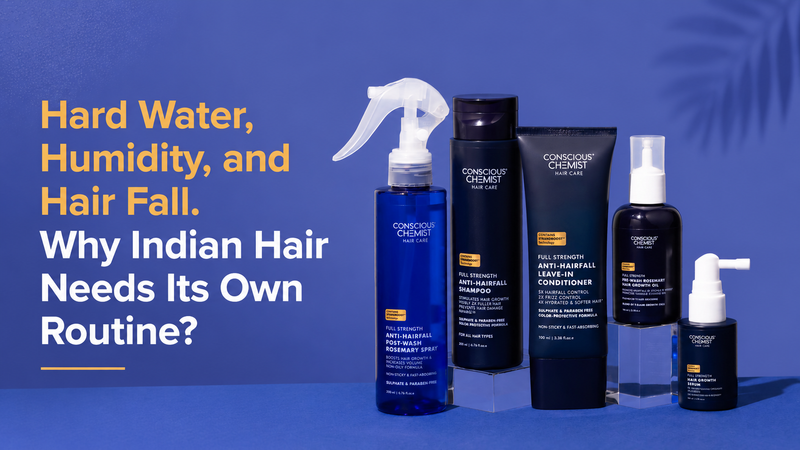
The Conscious Chemist Anti-Hairfall Shampoo and Conditioner help maintain clean roots and smooth lengths without heaviness, making it easier to manage hair in hard water conditions.
Order now and follow a lightweight routine to reduce buildup, improve detangling, and control frizz over time.
Frequently Asked Questions
1. Can hard water cause hair fall or just buildup?
Hard water mainly increases roughness and tangling, which can lead to breakage that looks like hair fall. Managing friction and residue helps reduce this effect.
2. What type of conditioner is best for fine hair in hard water?
A lightweight conditioner or leave-in works best. It provides slip without weighing hair down and helps maintain volume and movement.
3. Do silicones always cause buildup in hard water?
Not always. They can improve smoothness, but buildup usually happens when too many products are layered or not rinsed properly.
4. Can I use a leave-in conditioner every day?
Yes, if it is lightweight and applied in small amounts along the length. Adjust frequency if hair starts feeling heavy.
5. How do I remove buildup without drying my hair?
Use a clarifying wash occasionally, then follow with lightweight conditioning. Avoid frequent clarifying to prevent dryness.
6. Is this routine safe for colored or treated hair?
Yes, gentle cleansing and lightweight conditioning are suitable for treated hair and help reduce breakage over time.

Share:
How to Build a Hair Care Routine for Indian Hair That Fights Hair Fall and Frizz?
Salon vs At-Home Anti-Hairfall Routine: What Works Better for Hair Fall?