


Summer is here, and sunscreen should be non-negotiable. Yet, many people still avoid it. Why? Most sunscreens don’t feel good on the skin.
You apply it in the morning, and it feels fine at first. But within 10 to 15 minutes, your skin starts to feel greasy, oily, and heavy. Additionally, the heat and humidity of India make the situation even worse. Sweat mixes with the product, your face feels sticky, and the whole experience becomes uncomfortable.
This is exactly why people skip reapplication or stop using sunscreen altogether.
But that is not the right solution. What most people miss is that sunscreen is not just about protection. It is also about the texture and how it feels on your skin throughout the day.

That is why choosing a non-greasy sunscreen for daily use becomes important. The right formula can give you protection, a natural glow, and a finish that actually feels comfortable. This guide will help you choose the right sunscreen for a dewy finish.
What is the Difference between Dewy and Greasy Sunscreen Finish?
Before you change your skincare routine, you must identify the specific issue with your current sunscreen.
Many users use the word 'glow' to describe what they want, but end up with slickness in reality. Recognizing the difference helps you choose a product texture that suits your specific skin type and environment.
30-Second Sunscreen Check: Is Your SPF Dewy, Greasy, or Sticky?
You can determine your skin's state by looking for specific visual and physical cues.
-
Dewy Skin: This looks like soft light reflecting only on the high points of your face, such as your cheekbones and the bridge of your nose. It feels cushioned and hydrated.
-
Greasy Skin: This appears as a uniform shine across your entire face, including the forehead and chin. It feels slippery, or like a film is sitting on your pores.
-
Sticky Skin: This feels tacky. If you press your fingertips to your cheek and pull away, the skin offers resistance.
Why does Sunscreen become Greasy?
Greasy sunscreen is rarely the fault of one single factor. It often results from a combination of your skin type, the weather, and your application method.
-
Heavy Emollients: Some formulas use thick oils that are too heavy for oily or combination skin.
-
Layering Overload: Applying a thick moisturizer, a face oil, and then a heavy sunscreen creates a stack of products that cannot absorb.
-
Lack of Setting Time: If you don’t let your serum or moisturizer dry completely, the sunscreen slides around instead of forming a protective film.
-
Humidity: Moisture in the air prevents the sunscreen film from "drying down," which leads to a tacky sensation.
What to Look for on Sunscreen Labels?
You don’t need a degree in chemistry to find a better product. Scan the packaging for these specific terms that indicate a more sophisticated, lightweight formula:
-
Texture: Look for gel-cream, aqua gel, or water-based.
-
Finish: Seek out a weightless, invisible finish or a non-greasy finish.
-
Safety: Ensure the label says non-comedogenic (it will not clog pores) and broad-spectrum (it protects against both UVA and UVB rays).
-
Ratings: Aim for SPF 50 and a PA++++ rating for maximum protection.
|
Key Takeaway: Dewy sunscreen looks like soft light on your high points. Greasy sunscreen looks like an all-over shine and feels slippery or tacky to the touch. |
Dewy vs Greasy Sunscreen: Quick Diagnosis and Fix
If you are not sure what your sunscreen finish is telling you, this quick guide can help.
It breaks down the most common signs, what they usually mean, and the easiest fix that keeps your SPF routine effective.
|
What you notice |
What it means |
Quick fix that keeps SPF effective |
|
Glow on high points |
Balanced hydration |
Stay consistent |
|
Shine all over |
Heavy formula |
Switch to gel-based sunscreen |
|
Sticky feel after a few minutes |
Too many layers |
Apply thinner layers |
|
Makeup breaking apart |
Over-application |
Simlify routine |
|
Slippery feel |
Excess oils |
Choose lightweight SPF |
Which Ingredients and Textures Make Sunscreen Feel Lightweight and Dewy?
A lightweight, dewy sunscreen does not rely on oil. It depends on how the formula protects, spreads, absorbs, and holds moisture.
The right mix of technology, textures, and ingredients creates a soft glow that feels comfortable on the skin.
Here is how to identify what actually creates that comfortable glow:
-
Gel-Based Textures
Gel and water-resistant formulas feel lighter than creams. They:
-
Spread easily in thin layers
-
Absorb quickly
-
Don’t sit heavily on the skin
This is what gives a fresh, breathable finish instead of a greasy one.
-
Even Film Formation
A good sunscreen forms a thin and even layer on your skin. These include benefits like,
-
An even layer gives a soft glow
-
A thick or uneven layer looks shiny
-
Heavy application feels sticky
Modern sunscreen formulations are designed to improve spreadability and create a more comfortable finish.
-
Hybrid SPF Filters
Lightweight hybrid sunscreens combine mineral and organic filters. These filters help with:
-
Improve spread and texture
-
Reduce white cast
-
Feel lighter on the skin
A hybrid sunscreen combines mineral filters, such as Zinc Oxide, with organic chemical filters. Zinc Oxide is known for its structural properties and safety.
Modern hybrid sunscreens use encapsulation techniques. This process coats the particles, allowing them to spread easily. It provides broad-spectrum protection without the chalky white cast that often makes skin look dull.

-
Hydrating Ingredients
Dewy skin comes from hydration, not oil. A few examples of hydrating ingredients include:
-
Hyaluronic acid
-
Glycerin
-
Glycols
These ingredients pull moisture into the skin and create a soft glow.
-
Barrier and Antioxidant Support
These ingredients keep your skin balanced throughout the day.
-
Ceramides help prevent excess oil
-
Cholesterol supports the skin barrier
-
Antioxidants like vitamin C improve overall skin appearance
They help maintain that dewy look without turning greasy.
|
Key Takeaway: A lightweight dewy sunscreen is a thin, even layer that hydrates the skin and reflects light. It should never feel thick, oily, or sticky. |
Why is an Invisible Finish in an SPF Important?
If a sunscreen looks good and feels comfortable, you are more likely to use the correct amount.
Many people avoid sunscreen because it can leave an ashy or dull appearance. An invisible finish makes daily use easier and more consistent. Hence, it is advisable to choose the best sunscreens that don’t leave a white cast.
Statistics show that 84 percent of Black sunscreen users in the United States want more options tailored to their skin tones. An invisible finish ensures that you apply enough product to stay protected.
Lightweight Dew Checklist: What to Look for When Choosing a Sunscreen?
Here’s a table describing how to pick a sunscreen based on different scenarios and needs:
|
Need/scenario |
Feature to prioritize |
Example cue |
|
Oily or combination skin |
Lightweight gel texture |
Gel sunscreen, aqua-based, oil-free |
|
Humid or hot weather |
Fast-absorbing formula |
Lightweight, quick-dry, non-greasy |
|
Daily indoor and outdoor use |
No white cast finish |
Invisible finish, no residue |
|
Sensitive or acne-prone skin |
Non-comedogenic formula |
Won’t clog pores, dermatologist-tested |
|
Outdoor activity or sweating |
Water-resistant protection |
Sweat-resistant, water-resistant SPF |
|
Minimal skincare routine |
Multi-functional formula |
Hydrating sunscreen, moisturizer + SPF |
|
Uneven skin tone concerns |
Added skincare benefits |
With niacinamide, a brightening sunscreen |
Sunscreen Application Techniques for a Dewy Finish
Even if you are using a lightweight, non-greasy sunscreen, the wrong technique can spoil the feel and finish. A dewy finish often turns greasy because sunscreen is applied too thickly.
The right method provides full protection while keeping the texture light and comfortable.
Follow these simple steps to keep your sunscreen evenly distributed and breathable.
Technique 1: The Correct Order of Application
Always follow this sequence for the best results:
-
Cleanse your skin.
-
Apply lightweight serums.
-
Apply moisturizer. Only do this if your skin is dry.
-
Apply sunscreen as the final skincare step.
-
Wait for the sunscreen to set before applying makeup.
If you have oily skin, you can often skip the moisturizer. Many dewy sunscreens provide enough hydration to act as a two-in-one product.
|
Key Takeaway: Over-layering is one of the biggest reasons sunscreen feels greasy. |
Technique 2: Timing Your Layers to Avoid Stickiness
Giving your products time to absorb prevents pilling and stickiness. Follow these general rules:
-
Wait 30 to 60 seconds between your serum and your sunscreen.
-
Allow the sunscreen to dry for 2 to 3 minutes before applying foundation.
-
Apply your sun protection 15 minutes before you go outside.
This helps prevent pilling and improves the evenness of the sunscreen on your skin.
Technique 3: Apply the Right Amount Without Overloading
Using too much at once can make sunscreen feel heavy.
-
Use the two-finger method for the face and neck
-
Or use about one-fourth teaspoon for the face
Instead of one thick layer:
-
Apply in two thin layers
-
Let the first layer settle before the second
|
Key Takeaway: Two thin layers improve coverage and reduce stickiness. |
Technique 4: Reapply Without Ruining Your Finish
Reapplication is important, but it can make skin greasy if done incorrectly.
-
Reapply every 2 hours when outdoors
-
Reapply after sweating or wiping your face
-
Blot oil or sweat before reapplying
-
Apply in thin layers and blend gently
If you wear makeup:
-
Use small amounts
-
Pat, instead of rubbing

How to Use Dewy Sunscreen in Heat and Humidity to Avoid Greasiness?
Weather, sweat, and skin type can change how sunscreen feels throughout the day. What works in controlled conditions may start feeling heavy outdoors.
If you want a sunscreen for office use that is not greasy, here are a few tips:
How to Choose a Sunscreen for Hot and Humid Weather?
Humidity can make even good sunscreens feel sticky. The goal is to reduce excess layers. Here are some steps:
-
Skip heavy moisturizer and use a light hydrating serum
-
Use gel-based sunscreen instead of cream textures
-
Set only the T-zone with a small amount of powder
-
Blot sweat or oil before reapplying
-
Choose water-resistant formulas for outdoor use
|
Key Takeaway: In humid weather, the best routine is simple. Use fewer layers and choose a lightweight sunscreen that you will actually reapply. |
5 Signs Your Sunscreen is Heavy
Sometimes the issue is not your routine. It is the formula. Watch for these signs:
-
Skin feels sticky even after 10 minutes
-
Makeup starts breaking apart
-
You notice small bumps or clogged pores
-
Sunscreen moves into your eyes
-
Skin feels suffocated in the heat
If this happens, switch to a lighter, gel-based sunscreen with a breathable finish.
Example of a Comfortable, Dewy Sunscreen: Berry Bright
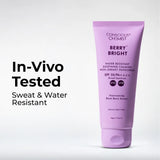
The Conscious Chemist Berry Bright Sunscreen SPF50 PA++++ is an example of a modern hybrid formula. It meets the criteria for a lightweight and dewy finish:
-
Hybrid Protection: It uses mineral and organic filters for high-level safety without a white cast.
-
Skincare Benefits: It contains 1 percent Niacinamide and berry extracts. These support the skin barrier and brighten the complexion.
-
Texture: The gel-like consistency works well for oily and combination skin types.
-
Durability: It is water-resistant. This makes it a reliable choice for humid weather.
Who Should Use Berry Bright Sunscreen?
This type of sunscreen works well for:
-
Oily and combination skin
-
People living in hot or humid climates
-
Anyone looking for a dewy finish without greasiness
-
If you have sensitive skin, do a patch test before regular use and discontinue if irritation occurs.
Frequently Asked Questions
-
How do I get a dewy sunscreen finish without looking oily?
Use fewer layers underneath your sunscreen. Choose a lightweight gel or gel-cream sunscreen. Apply the product in two thin layers. If you get shiny fast, lightly set only the T-zone, then blot before reapplying.
-
Does a dewy sunscreen mean it is less effective?
No. Finish does not determine protection. The amount you apply and how evenly it spreads to form a film matter more. Use the two-finger method and reapply every 2 hours when outdoors.
-
Why does my sunscreen feel sticky in humidity?
Humidity can keep sunscreen films from fully setting. Heavy layering makes it worse. Try waiting 1 to 2 minutes between layers. Apply thinner coats and choose a water-resistant formula.
-
What is a hybrid sunscreen, and is it better for oily skin?
Hybrid sunscreens combine mineral and organic UV filters. They balance broad-spectrum protection with better spreadability. Many people with oily or combination skin find that hybrid formulas feel lighter and leave less white cast.
-
How often should I reapply sunscreen if I am indoors?
If you are away from windows and not sweating, you may not need to reapply as often. Many people reapply once mid-day. If you are near bright windows or commuting, stick closer to every two hours.
-
Can niacinamide in sunscreen help with pigmentation?
Niacinamide can help strengthen the barrier and achieve a more even-looking tone over time. It does not replace sunscreen. Think of it as a helpful add-on while broad-spectrum SPF does the heavy lifting.
Share:
How to Choose a Sunscreen with No White Cast for Indian Skin Tones?
How Daily Sunscreen in Your 20s Prevents Tanning, Dullness, and Dark Spots?