

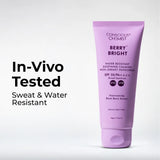

You put on sunscreen before you head out. You even reapply when you can. But the moment you start sweating in the gym, walking to work, playing a match or dancing at the beach… your sunscreen melts away, disappearing into a greasy mess. And suddenly you are left unprotected all over again.
It feels unfair. You are making the effort, why isn’t your sunscreen keeping up?
The problem isn’t you. It’s the formula.
Most sunscreens are designed for slow, still mornings. Not a fast-paced, humid, real-life day. If your sunscreen can’t handle sweat, movement and heat, it’s only doing half the job.
Water-resistant sunscreens change that. They stay put when you’re active, when the sun is strong and when the humidity is unforgiving.
This guide will show you how water resistance works, what labels really mean, and how to choose an SPF that stays put. Because protection shouldn’t pause just because you decide to move.
What “Water-Resistant” Actually Means on an SPF Label
Water resistance is not just a marketing phrase. It is a regulated claim that tells you how long a sunscreen can maintain protection when your skin gets wet or sweaty.
“Water-resistant 40 minutes” vs “Very water-resistant 80 minutes”
Here’s what the numbers mean on your tube:
• Water-resistant 40 minutes
Protection holds during light sweating or a short swim
• Very water-resistant 80 minutes
Protection stays more stable during heavy sweat or longer water exposure
• If a sunscreen has no water-resistance claim, protection can wash off quickly
Regulatory & Testing Framework
The U.S. FDA requires:
• Water-resistant claims must specify 40 or 80 minutes
• Testing must include immersion + drying cycles
• SPF must remain effective for the stated time while swimming or sweating
Real meaning for you:
• 40-minute claim: for mild daily activity
• 80-minute claim: for gym, sports, outdoor heat, beaches
The higher the number, the better the sunscreen performs under real-life movement.
Why Regular Sunscreens Fail Mid-Workout
You may be doing everything right — applying SPF daily, using a high number like 50…. yet still tanning around the forehead, nose or under the eyes.
That doesn’t mean SPF isn’t working.
It means your day includes sweat, heat and friction… and your sunscreen isn’t built for that.
Sweat + Heat Break the SPF Film
During exercise or even a hot commute, your skin heats up and produces moisture. That changes how sunscreen behaves:
• Sweat loosens the UV filter layer
• Salt and oil in sweat dissolve creamy textures faster
• Heat causes SPF to melt and move away from where you need it
This is why tanning often starts on the temples, nose and upper lip: the first areas that sweat.
|
Challenge |
What Happens to SPF Film |
What to Look For in a Formula |
|
Sweat |
Sweat dissolves and loosens the SPF layer, creating gaps—especially on temples, nose, and upper lip. |
Film-forming polymers, sweat-resistant systems, 80-min water resistance. |
|
Humidity |
Moisture softens the sunscreen texture, causing it to melt, slide, or become patchy. |
Lightweight gel / hybrid textures, humidity-proof emulsifiers, non-greasy finish. |
|
Motion |
Friction from wiping, collars, straps, helmets breaks the SPF film unevenly. |
Fast-set technology, matte/semi-matte dry-down, long-wear film networks. |
Real-life failures: dripping, sliding, patchiness under sweat
Even small actions throughout the day can erase SPF:
• Dabbing your face with a tissue
• Shirt collar rubbing while walking
• Helmet strap sitting against temples
• Wiping sweat from your forehead
The result: invisible gaps where UV hits unprotected skin — and that’s exactly where you notice bronze patches or redness.
Key Formulation Fixes: What Makes SPF Stay Put
Water-resistant sunscreens use smarter formulation technologies to stay in place during movement, heat and sweat.
Look for these on the label or product description:
• Film-forming polymers
Help the sunscreen set on the skin like a breathable mesh
• Sweat-resistant systems
Keep UV filters from dissolving when moisture appears
• Water-resistant emulsifiers
Prevent the product from washing away quickly
• Lightweight gel or hybrid textures
Stay anchored even in humid weather without melting
These elements ensure UV filters remain evenly distributed on skin for longer.
That means your sunscreen continues protecting where you originally applied it — not migrating into your eyes or off your nose mid-workout.
Testing Methods: Why 80-Minute Water Resistance Matters
Not all water-resistant sunscreens are created equal. Some survive sweat better because they are tested and formulated differently.
Understanding how this testing works helps you pick the sunscreen that won’t disappear the moment you start moving.
How Water Resistance Is Tested (Immersion + Drying Cycles)
To earn a water-resistant claim, a sunscreen must prove that its SPF value remains stable while the wearer is sweating or in water.
Regulators such as the U.S. FDA and international standards (like ISO 16217) require:
• Application of sunscreen on skin
• Immersion in water for controlled time periods
• Drying cycles in between
• SPF re-measured to confirm protection remains intact
This simulates real-life: swimming, sweating, wiping, cooling down, and starting again.
If SPF drops significantly during testing → the formula cannot claim water resistance.
What the 80-Minute Claim Means in Real Life
An 80-minute claim means the sunscreen continues to protect during:
• A full sports session
• An intense gym workout
• Long outdoor commuting in heat
In practical terms:
80 minutes = higher confidence under sweat, friction and water exposure
40 minutes = good for lighter activity like a quick walk outdoors
If you sweat easily, even just under the sun while standing, go for 80 minutes.
What to Look for on the Label (and Why It Matters)
The right claims allow you to trust that sunscreen isn’t sliding off while you move.
Look for clear mentions such as:
• Water-resistant 80 min
• Sweat-resistant or sport formulation
• Film-forming polymers (holds the filter layer in place)
• Hybrid filters (better stability without white cast)
• Broad-spectrum SPF 50 + PA++++
These clues tell you the product was made for real human movement, not perfect indoor conditions.
Water-Resistance Claims & What They Mean
|
Label claim |
Protection holds for |
Best for |
|
Water-resistant 40 minutes |
Sweat or water exposure for shorter duration |
Quick outdoor tasks, casual walks |
|
Very water-resistant 80 minutes |
Sweat, heat and water exposure for longer activity |
Workouts, sports, beaches, high humidity days |
Hybrid SPFs That Stay Put Without Suffocating Your Skin
If you’ve ever felt a sunscreen become greasy the moment you sweat, the formula was likely not built for movement.
Hybrid SPFs are designed to avoid that problem by pairing strong protection with comfortable wear — so you forget you’re even wearing sunscreen.
What a Hybrid SPF Actually Means
A hybrid sunscreen uses:
• Chemical filters to absorb UV rays
• Mineral filters to reflect UV rays
• Film-forming technology to keep protection in place during sweat or motion
This combination helps keep your skin protected without the heavy white cast or sticky feel that comes from older, thicker formulas.
Features to Prioritise for Active, Humid Conditions
If your day includes sweat — even light sweat — look for these five essentials:
• SPF 50 + PA++++ for full-spectrum protection
• Water-resistant 80 minutes for sweat stability
• Matte or semi-matte finish to avoid melting shine
• Non-comedogenic to prevent clogged pores after a workout
• Quick-dry gel or gel-cream texture so it doesn’t move when you do
Quick rule: If the sunscreen feels like a thick moisturiser, it’s not built for your active lifestyle.
How a Modern Hybrid Can Support Your Routine
A high-performance hybrid SPF can simplify your skincare on busy days.
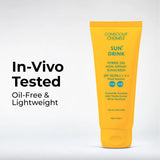
For example: Our Sun Drink Unwind SPF 50 features:
• Film-forming network for grip during heat
• 80-minute water resistance for sport or long commutes
• Lightweight finish so skin stays comfortable and breathable
• Designed for humid Indian weather and deeper skin tones
• Tested for real-world movement
In internal user testing:
95 percent reported no film breakdown after a 1-hour run,
and 9/10 said their skin felt less greasy than with regular SPF.
It protects like sunscreen. It behaves like part of your lifestyle.
Takeaway
If your sunscreen stops protecting the moment you start moving, it’s not designed for your real life.
Look for water-resistant, hybrid SPFs that promise at least 80 minutes of protection, use film-forming technology, and stay comfortable even when you don’t.
Conscious Chemist’s Sun Drink Unwind Edition delivers: protection that flexes, breathes, and moves with you, from the gym to your commute to the beach.
FAQs
Q. What does “water-resistant 80 minutes” mean?
It stays effective for up to 80 minutes while you sweat or swim before you need to reapply.
Q. Do I need it if I don’t swim?
Yes — sweat and humidity can break down SPF too, even on regular days.
Q. Can I use it daily?
Absolutely. It’s lightweight, breathable, and great for everyday wear.
Q. How often should I reapply?
Every 2 hours, or sooner if you’re sweating or wiping your face.
Q. Is it good for oily or acne-prone skin?
Yes. It’s oil-free, non-comedogenic, and barrier-strengthening.
Share:
Understanding SPF, PA++++, and Blue Light: The Complete Guide to Modern Sun Protection
Why Is My Skin Getting Darker Even Indoors? The Hidden Causes of Tanning You Didn’t Expect